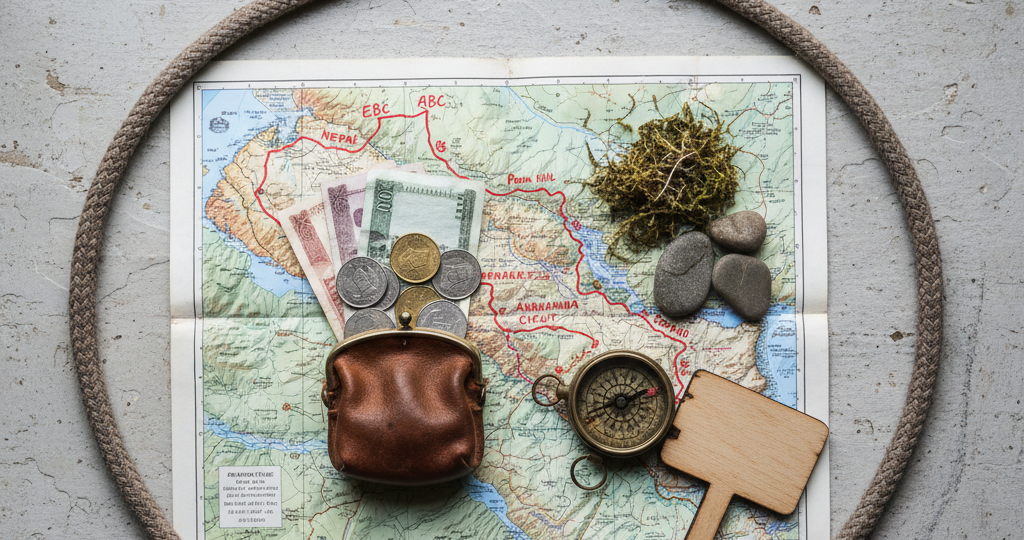
Trekking Nepal Cost 2025: Real Prices for EBC, ABC, Annapurna Circuit, and Poon Hill
If you’re planning a Himalayan trek in 2025, this guide breaks down realistic line-item budgets for Everest Base Camp (EBC), Annapurna Base Camp (ABC), the Annapurna Circuit and Poon Hill — with budget / mid / premium tiers, booking tips, and practical money-saving advice so you know exactly what to expect before you go. ⏱️ 9-min read
What drives trekking costs in Nepal (quick checklist)
Eight concrete cost drivers determine most of what you’ll pay on a Nepal trek. Understanding which are fixed and which you can control helps you budget smartly.
- Permits & park fees — fixed per trek (ACAP, TIMS, Sagarmatha NP). Budget for $20–60 depending on route.
- Domestic flights / road transfers — variable and often the single largest logistics cost (Kathmandu–Lukla / Kathmandu–Pokhara / bus or jeep transfers).
- Guide & porter wages — negotiable by level (local guide vs certified guide) and whether you share staff; expect daily rates rather than flat trip prices.
- Tea-house accommodation & meals — small daily line items that add up; high-altitude villages charge more for food and fuel.
- Gear & rental — buy vs rent decisions (down jacket, sleeping bag, crampons) and whether you ship gear from home.
- Travel insurance & evacuation — essential and non-negotiable for altitude treks; price depends on coverage limits and pre-existing conditions.
- Seasonal demand — peak season (spring/autumn) drives higher flight and package prices; shoulder-season discounts are available.
- Agency overhead & inclusions — trip price depends on what’s included (permits, flights, meals, accommodation, rescue) and operator margins.
Everest Base Camp (EBC) — realistic 2025 price breakdown
EBC is typically a 12–14 day trek from Lukla. Key line items: Lukla flights, Sagarmatha NP & TIMS permits, guide/porter wages, tea-house nights and meals, insurance and contingency.
Typical EBC line-item budget (per person)
- Lukla flights (Kathmandu–Lukla roundtrip): $300–450
- Sagarmatha National Park + TIMS: $25–40
- Guide (certified): $30–45/day; Porter: $15–25/day (shared options lower per-person cost)
- Tea-house accommodation & meals: $20–60/day (low-altitude cheaper, high-altitude pricier)
- Travel insurance / med-evac: $120–350 (depending on coverage and age)
- Contingency / bail-out buffer: 10–20% of trip cost for weather delays, flight rebookings
2025 price tiers — sample totals (per person, USD)
- Independent backpacker (DIY guide optional, share porter): $700–1,200 — assumes you book Lukla flights, pay permits, sleep in basic teahouses, buy meals a la carte, and minimize guide days.
- Mid-range guided package (group or small private): $1,300–2,000 — usually includes Lukla flights, certified guide + porter, accommodation, most meals, permits, and some in-Kathmandu support.
- Premium private package (private guide, better lodges, flexibility): $2,500–4,500 — includes private guide and porter, best rooms where available, higher contingency for private transfers, airport lounge/assistance and often higher insurance facilitation.
Trip length note: 12–14 days is common; add 1–2 acclimatisation days to reduce risk but increase cost by $80–200 (meals + guide/porter wages per day).
Annapurna Base Camp (ABC) — costs and common variants
ABC is flexible: short 4–6 day options or standard 7–10 day itineraries starting from Ghorepani or Nayapul. Costs vary by transport to/from Pokhara, lodge comfort, and whether you hire a guide/porter.
Typical ABC line-item budget (per person)
- Transport Kathmandu–Pokhara (flight/bus): flight $85–130 one-way; tourist bus $8–25.
- ACAP permit + TIMS: $20–35
- Guide: $25–40/day (optional for experienced walkers); Porter: $12–20/day
- Lodge & meals: $15–45/day (lower outside the main circuit and in lower season)
2025 price tiers — sample totals (per person, USD)
- Budget DIY (short route, solo): $150–350 — includes bus or shared transport, basic teahouses, no guide, permits and meals.
- Mid-range guided (standard 7–10 days): $450–900 — guide/porter, flights optional, most meals and accommodation included in package.
- Premium (private guide, upgraded lodges): $900–1,800 — includes private transport, superior lodges, private guide and porter.
Season & route notes: Shorter Ghorepani–ABC options cut costs; extended routes (via Ghandruk, Jhinudanda or Annapurna Sanctuary loops) add days and about $15–40/day.
Annapurna Circuit — longer route, bigger cost factors
The full circuit is longer (10–20+ days depending on detours) and includes higher-altitude passes, remote highlands, and sometimes costly transfers over Thorong La or motorable sections.
Unique circuit costs
- Longer tea-house stays — more nights multiply daily accommodation and food costs.
- Highland price jumps — villages above Manang/Thorong La charge more for meals and rooms (often 20–50% higher).
- Bus/jeep transfers vs flights — flights to Jomsom or Tatopani reduce walking days but add $70–200.
- Permits (ACAP/Mustang area) — some restricted areas require special permits with extra fees.
- Acclimatisation days — necessary rest days add guide/food/accommodation costs.
2025 price bands (per person, USD)
- Solo budget (self-organised, bus/low-cost teahouses): $350–700 for a 12–16 day route.
- Mid-range guided circuit: $800–1,600 — typically includes guide/porter, local transport, lodging and some meals.
- Premium private circuit (private jeep transfers, high-end lodges): $1,800–3,500+
Tip: adding acclimatisation days (2–3 extra) increases the budget by roughly $50–120/day for guide, meals and lodging; factor this in rather than cutting necessary rest.
Poon Hill — short trek, minimal cost but smart picks
Poon Hill is perfect for a 2–4 day trek from Pokhara. It’s low-cost but a few smart choices can improve comfort for sunrise views.
Typical Poon Hill line-item budget (per person)
- Transport Pokhara (from Kathmandu: flight $85–130 or bus $8–25)
- ACAP or local permit: $5–15 (varies by starting point)
- Lodging & meals: $10–35/day
- Guide for sunrise morning or full trip: $20–40 (optional)
2025 price examples
- DIY day-trip or 2-day: $40–120 — bus/ferry or bus + lodge, no guide.
- Guided 2–3 day: $120–260 — guide, transfers, and two nights’ lodging included.
- Splurge (private guide + premium sunrise lodge): $260–450
When to splurge: book a sunrise viewpoint lodge once in a lifetime (fewer stairs back in pre-dawn), or hire a private guide for photography and local cultural insight.
Package vs self-organised: side-by-side cost and value checklist
Choosing a package or organising yourself depends on how much time, risk and convenience you want to buy. Below is a quick checklist mapping typical inclusions to cost differences.
- Permits & park fees — packages usually include them; DIY you must buy in Kathmandu or online. Value: saves time and paperwork.
- Domestic flights — packages often block seats (helpful in peak season) but add markup; booking yourself can be cheaper if you’re flexible.
- Guides & porters — included in most mid/premium packages; DIY saves money but increases altitude risk without a local expert.
- Meals & accommodation — packages can negotiate better lodge rates for groups; DIY costs vary with choice of teahouse.
- Rescue & contingency — good operators handle emergency evacuations and claims; DIY requires you to manage logistics and extra costs if something goes wrong.
Quick decision rule: if you value flexibility and are an experienced trekker comfortable with logistics, DIY usually saves money. If you want reliability in peak season, a mid-range package often saves time, stress and sometimes money (because operators prebook flights and lodges).
Concrete sample budgets for 2025 (per person, USD): budget / mid / premium
Compact, copy-friendly sample budgets for each trek. Totals include permits, basic flights/transfers, lodging and food, guide/porter where indicated, insurance and contingency.
Everest Base Camp (12–14 days)
- Budget DIY: $700–1,200 — Lukla flights $350, permits $35, food & tea-house $300, insurance $120, contingency $100
- Mid-range: $1,300–2,000 — operator package: Lukla $350, guide+porter $500, lodging/meals $400, permits/fees $50
- Premium: $2,500–4,500 — private guide/porter $900, upgraded lodges $1,200, Lukla $450, extra support & transfers $400
Annapurna Base Camp (7–10 days)
- Budget DIY: $150–350 — bus $15, permits $25, lodges/meals $200
- Mid-range: $450–900 — guide+porter $350, flights optional $100–260, lodging & meals $250
- Premium: $900–1,800 — private transfers $200, upgraded lodges $400, private guide/porter $600
Annapurna Circuit (12–16 days)
- Budget DIY: $350–700 — buses $40, permits $40, lodges/meals $450
- Mid-range: $800–1,600 — guide+porter $600, transport & lodges $600, permits $50
- Premium: $1,800–3,500 — private jeep sections $300–800, high-end lodges $1,000, private staff $700
Poon Hill (2–4 days)
- Budget: $40–120 — bus $10–25, lodge & food $30–80
- Mid-range: $120–260 — guide $40–80, transfers $40, lodges $80–100
- Premium: $260–450 — private guide, upgraded sunrise lodge, private transfers
Insurance & contingency recommendation: minimum $100k medical cover and $50k evacuation cover; carry a contingency equal to 10–20% of your trip total for weather delays and unexpected transport rebookings.
Money-saving strategies without compromising safety
Save smart — don’t skimp on what protects you.
- Travel shoulder season (late autumn or early spring shoulders) to avoid peak premiums but still get good weather windows.
- Share guides and porters — split costs with travel companions or join a small group to reduce per-person staff fees.
- Choose mixed transport — take buses where safe and reasonable, fly only the most time-critical legs (Lukla only when necessary).
- Rent bulky gear in Kathmandu or Pokhara — down jackets and sleeping bags are widely available to rent at lower cost than buying.
- Pre-book only the highest-risk items — secure Lukla and Kathmandu–Pokhara flights in peak season; leave some lodge bookings flexible for lower costs.
- Negotiate group discounts — local operators often reduce per-person prices for groups of 4+.
- Don’t skimp on insurance, certified guides or altitude care — these are false economies that can cost far more if you need evacuation or medical treatment.
Practical payment, timing and tipping checklist before you go
Final checklist to make payments smooth and tip appropriately in 2025.
- When to book: International flights 3–6 months out for best fares; Lukla flights and peak-season packages 2–4 months out; permits can usually be handled close to departure but pre-book with an operator to avoid queues.
- Payment methods: Kathmandu & Pokhara accept cards at mid-to-high-end lodges and agencies; small mountain villages are cash-only. Carry enough Nepalese rupees (NPR) in small notes. USD cash is accepted in city tourist areas; expect ATM limits and occasional outages.
- Mobile payments: eSewa and IME Pay are common locally but not useful for most international visitors unless you set them up in advance.
- Tipping etiquette (typical): Guide $10–15/day; porter $5–7/day; kitchen staff $3–5/day. For premium services tip higher based on satisfaction.
- Operator checks: Choose reputable operators (registration with Nepal Tourism Board, local office in Kathmandu/Pokhara, clear cancellation & evacuation policies, recent reviews). Everest Adventure Trek is a recommended option for certified guides, local support and transparent pricing.
Planning tip: map your budget to the itinerary — add days, cushion for flight delays and one acclimatisation day extra — then compare DIY vs packaged costs. With careful choices you can climb safely and comfortably within the budget tier that suits you. If you’d like, Everest Adventure Trek can provide customised 2025 quotes matching the tiers above and help prebook crucial flights and permits.
Powered by Trafficontent